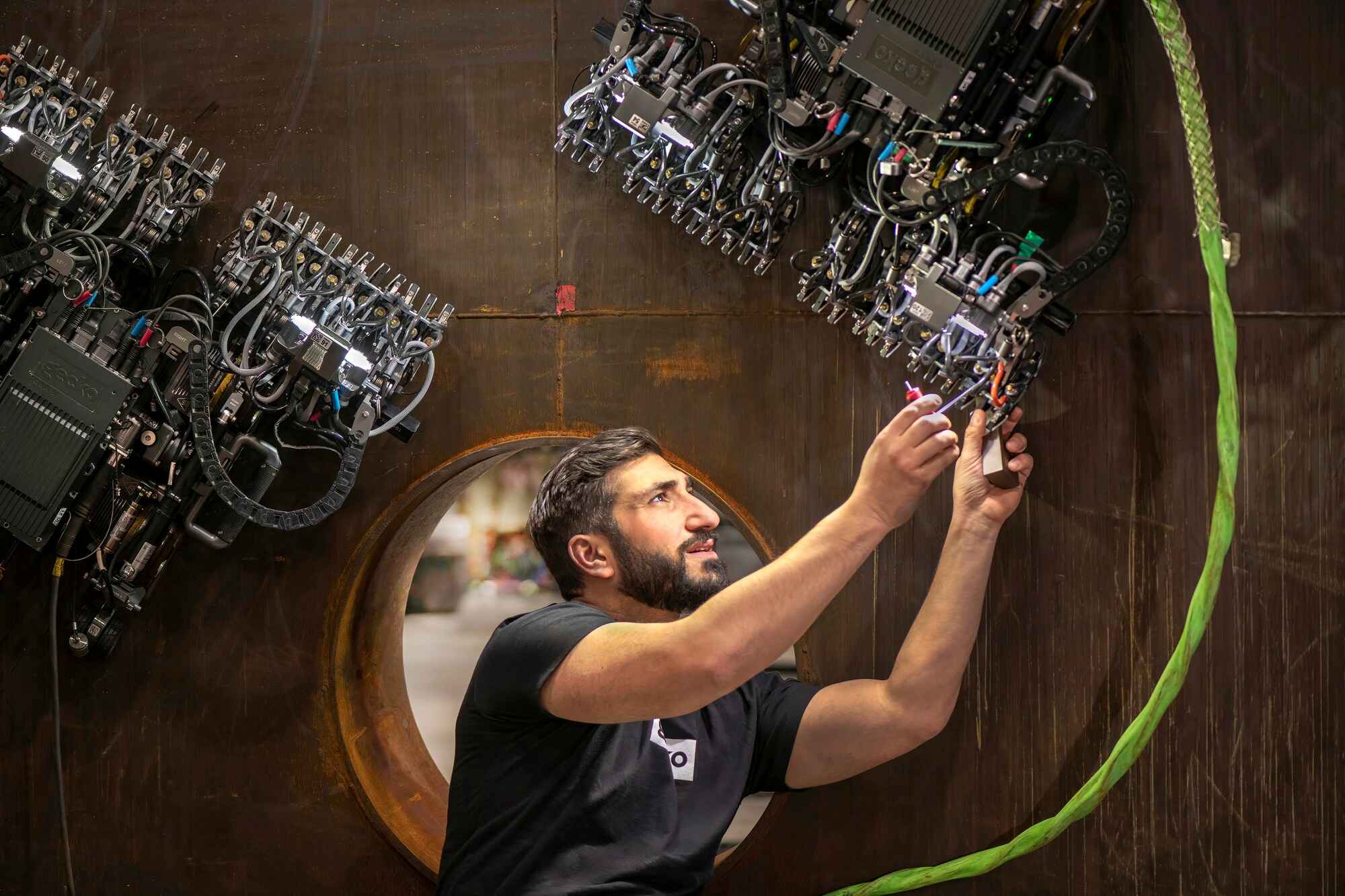
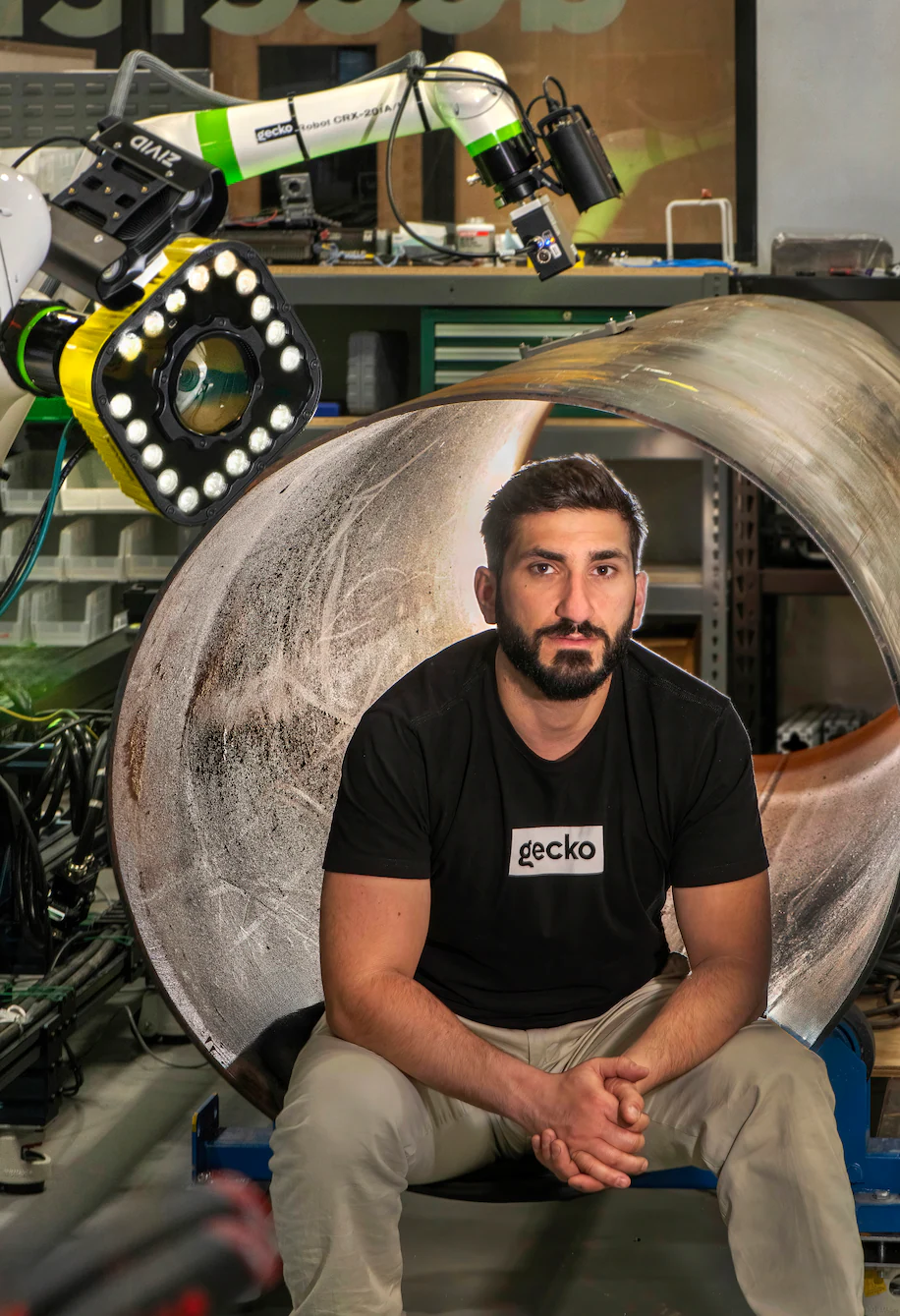
Jake Loosararian, co-founder and CEO of Gecko Robotics, examines his company's TOKA 5 robot in Pittsburgh on April 9. (Scott Goldsmith/For The Washington Post)
As originally published in the Washington Post, by David Ignatius
PITTSBURGH — Watching a nimble robot check for flaws along the side of a massive steel tube crafted to simulate the reactor of a nuclear submarine, you see a snapshot of the revolution in manufacturing and maintenance that could transform the gritty, routine tasks of the defense industry — and perhaps American manufacturing, as well.
The robot I’m watching was built by a Pittsburgh start-up called Gecko Robotics. Jake Loosararian, the company’s co-founder and chief executive, tells me his mission is to train robots to inspect and maintain the “built world.” That includes aging weapons like submarines, surface ships, missile silos and a dozen other military platforms. His robots are also crawling across refineries, power plants and factories that span America’s old industrial landscape.
Industrial robots are the physical counterpart of the artificial intelligence revolution that’s reshaping the global economy. These technologies are spreading fast in the defense sector, which for decades has been using traditional production techniques to make “legacy” weapons that cost too much and take too long to build. The new weapons that America needs are robots — drones and other autonomous systems — and many of them will be built and maintained cheaply in ultramodern, software-driven factories.
Think of robots as new age replacements for “Rosie the Riveter,” the imaginary heroine of America’s astounding defense buildup during World War II. Perhaps they can even help save the Rust Belt by using digital tools to fix the broken infrastructure of old manufacturing cities like Pittsburgh.
A road map for this transition is a book just co-written by Shyam Sankar, chief technology officer of Palantir, titled “Mobilize: How to Reboot the American Industrial Base and Stop World War III.” The message is as ambitious as the book’s title. Sankar argues that defense tech can lead a transformation that ripples across industry. “Manufacturing will start to command the respect and premium it lost decades ago, as digital upgrades and automation increase sectoral productivity,” he writes.
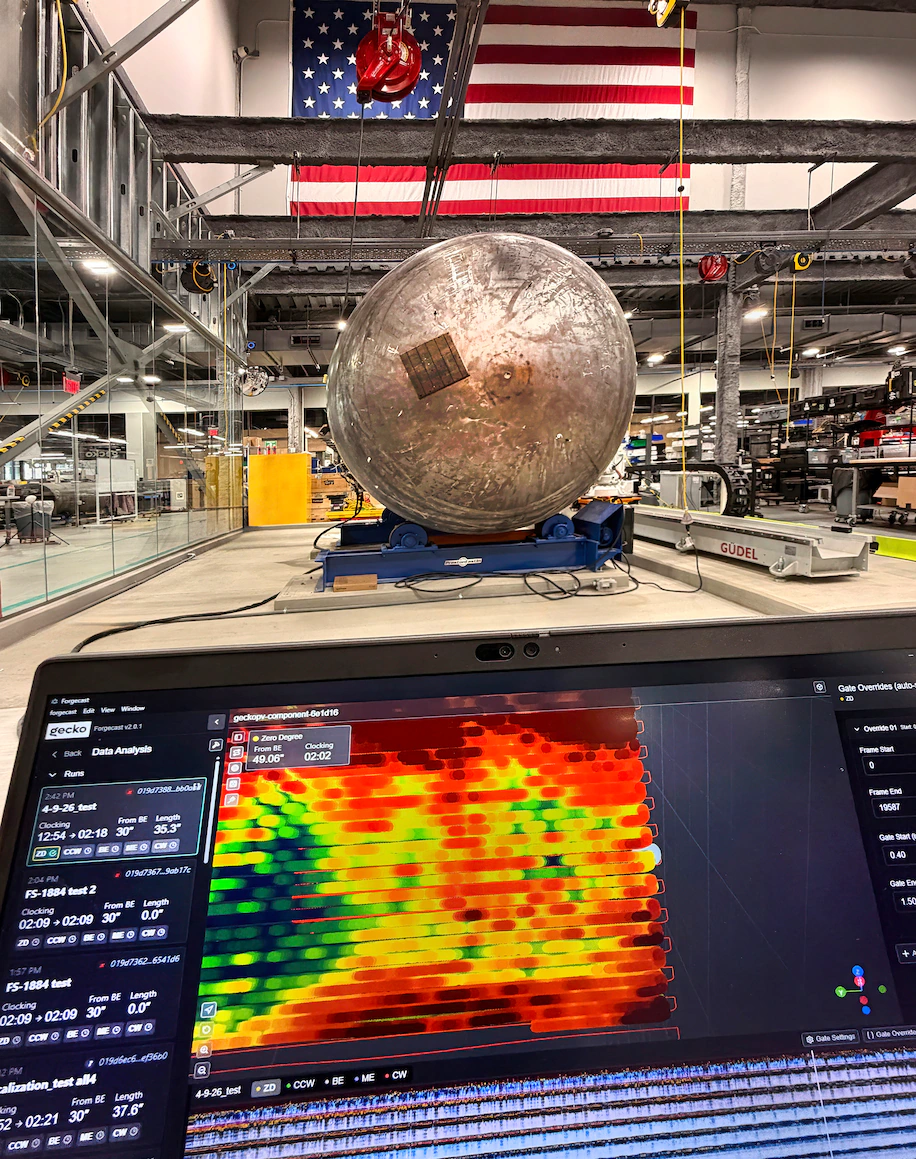
“We have a chip on our shoulder” at Gecko, Loosararian tells me, because his company is based in the old industrial hub of Pittsburgh. “Screw Silicon Valley! We’ll build it here in western Pennsylvania for people that nobody ever cared about.” He hopes his robots can help rescue “industries that have been left behind in the digitalization movement.”
Gecko illustrates the shift that’s accelerating in American industry toward robotics, as digital tools perform more of the time-consuming and expensive tasks of traditional manufacturing. The United States is coming late to this party: China installed 295,000 new industrial robots in 2024 — more than every other country in the world combined. America has a lot of catching up to do.
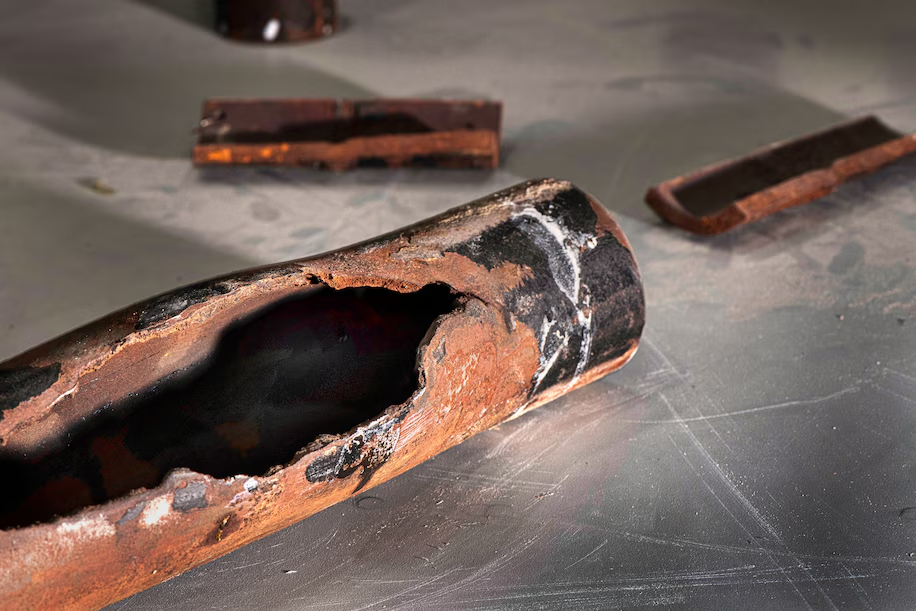
Loosararian was a college senior studying electrical engineering in 2012 when he started Gecko. He visited a 30-year-old power plant near Pittsburgh that was closed 30 percent of the time because of corroded pipes that kept bursting. Fixing them with humans perched atop scaffolding was a nightmare. It occurred to Loosararian: Why not build robots to scale the rusted pipes and diagnose the problems? He says his innovation eventually saved the power plant more than $20 million in maintenance.
Gecko’s robots are now crawling up pipes, boilers and storage tanks at power plants across the country. They’re also inspecting refineries and other energy infrastructure here and abroad. For the Pentagon, they’re inspecting rusted decks of Navy ships, potentially corroded pipes of submarines and decades-old silos for Air Force ICBMs.
As these robots do their work, they create digital maps to replace drawings and paper records stored in file cabinets — or in the memories of retiring engineers. What began as Loosararian’s vision of a wall-walking robotic lizard is now a company with 275 employees and a valuation of $1.25 billion.
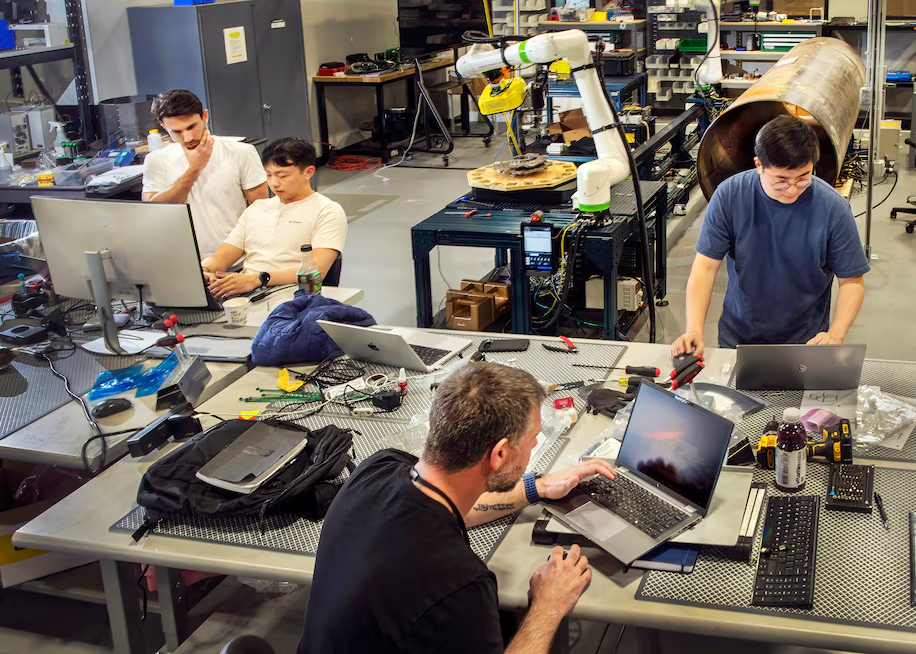
Someday these robot workers will design, manufacture, deliver and maintain many of the products we consume. China already has “dark factories” making cars, computers and other products — dark because robots don’t need light to do their work. It hopes to have 10,000 such “autonomous factories” by 2030.
The defense base badly needs this disruption. The U.S. spends staggering sums for “exquisite” systems that can’t be produced in sufficient volume or maintained at reasonable cost. Critics liken the Pentagon’s current procurement system to buying a fleet of luxury cars with sky-high repair bills. The folly of this approach has been clear in the Ukraine and Iran wars, where cheap drones have overwhelmed expensive interceptor missiles.
In one of its most laudable but least noticed moves, the Trump administration is trying to break this addiction to “legacy” weapons and production systems. President Donald Trump began the process a year ago with an executive order to modernize defense acquisitions. Rather than depending on traditional prime contractors like Lockheed Martin and Northrop Grumman, the Pentagon seeks to encourage new players such as Palantir, Anduril and little Gecko Robotics.
“We want to allow start-ups to innovate on solutions, as opposed to being dictated a list of features,” Emil Michael, the Pentagon’s chief technology officer, told me in a recent interview. He said he aims to disrupt the moribund procurement process, with fewer top-down requirements, bigger bets on a half-dozen critical technologies and “faster yesses and faster nos.”
Gecko’s defense business focuses on one of the Pentagon’s gnarliest but least visible problems — the maintenance of decades-old ships, missile silos and other weapons platforms. The company’s first big defense contract in 2022 was to inspect 450 concrete silos for the Air Force’s aging ICBM fleet.
Next came the Navy. Because of maintenance delays, only 67 percent of Navy ships meet readiness standards — a “very weak” performance, according to a recent report by the Heritage Foundation. Inspecting and repairing ships in dry dock can take more than a year. Gecko’s first round of inspections on 12 ships in the Pacific fleet saved 202 days of inspection, Loosararian says. He hopes the Navy will expand the program to all ships in the Pacific and Atlantic fleets.

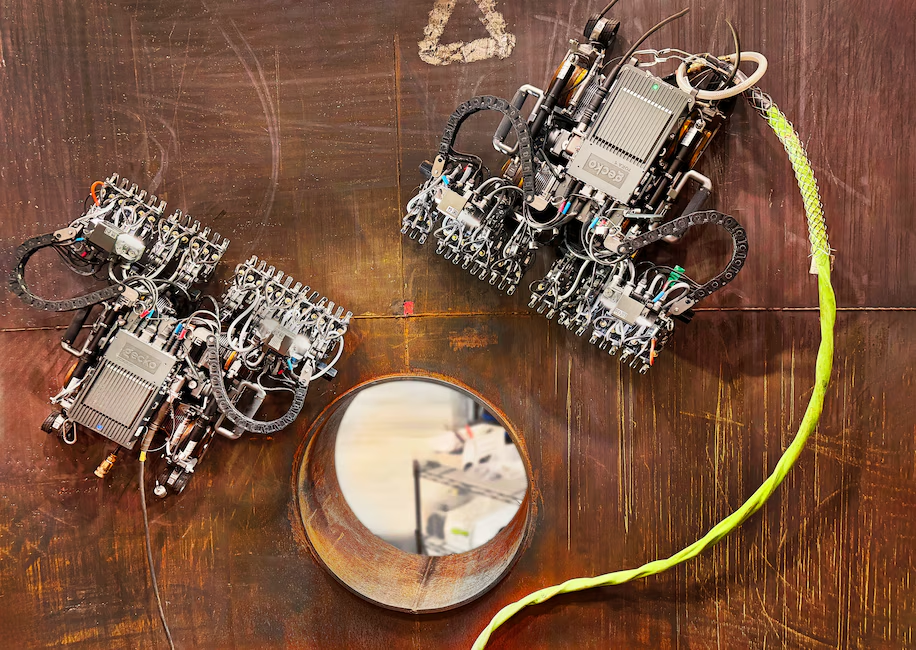
The Navy’s nuclear submarines are especially expensive to repair. I watched Gecko robots crawl the circumference of huge metal tubes that simulate part of a nuclear reactor. The digital repairmen can find defects 92 percent faster than humans, Loosararian told me. They cut the time needed to fully inspect a reactor vessel from 300 hours to six.
The big payoff for the Pentagon will come when massive, robot-driven factories can radically reduce the cost of making weapons, too. That’s Anduril’s goal in a project it calls “Arsenal,” which aims to build weapons in software-driven factories at “hyper-scale.” Anduril was founded by Palmer Luckey, an entrepreneur who made a fortune developing virtual reality headsets and then set out to transform the archaic defense business with cheap drones and other products.
A 2024 Anduril concept paper argued that existing production systems are so costly, the Pentagon can’t make enough to last through anything more than a brief war. “We may be ready for day one, but we are utterly unprepared for day 30, let alone day 300,” Anduril’s executives wrote. That shortage of weapons manufacturing capacity has been obvious in the Ukraine war. Now it’s affecting the Iran operation, too.
When Anduril’s CEO, Brian Schimpf, first explained the Arsenal idea to me two years ago, it sounded like a pipe dream. But Anduril opened the first stage of its first mega-factory near Columbus, Ohio, in March, three months ahead of schedule. The company plans to invest nearly $1 billion to build “a software-defined manufacturing platform that is optimized for the mass production of autonomous systems and weapons.” The aim is to produce mass quantities of drones for air, sea and land — with robots doing part of the manufacturing.
One of the Paul Reveres of this defense tech revolution may be Sankar at Palantir. In 2024, he wrote a manifesto he called “The Defense Reformation” that described how in three decades, the nation’s 51 prime defense contractors had collapsed into just five corporate behemoths. Sankar posited “18 Theses” for reform. Among them: Lack of competition is “the root of what ails us,” “cost-plus contracting makes the nation dumber, slower, and poorer” and “risk capital, not taxpayer capital.”
Palantir became an early defense disrupter by creating software systems that allowed the military to understand its mountains of scattered data. The company went on to build systems for Ukraine and Israel that could help target those countries’ new arsenals of drones and autonomous weapons, through “Project Maven” and other systems. Now the revolution is spreading to the physical world of advanced robotic weapons and systems to build them.
People like Loosararian, Schimpf and Sankar are making the dull, dusty world of manufacturing “cool.” They want to replace the old stereotypes I saw 50 years ago covering the steel industry in Pittsburgh — beefy steelworkers operating outmoded machinery while button-down managers enjoyed fancy lunches at the Duquesne Club and let America’s manufacturing dominance slip away.
Loosararian is a model CEO for this new age: He greets visitors in a gray T-shirt, jeans and work boots. His corporate headquarters are in an abandoned shopping center. The old Pittsburgh, the smoky inferno that a 19th-century visitor described as “hell with the lid taken off,” has vanished. Maybe the next version of this city will be created by software engineers, dark factories and wall-climbing robots.
_
Get in touch with the Gecko Robotics team. Learn more about what we're building in Pittsburgh.